
The best dust collector will also help maintain your health. Are you completely over the fine dust that clogs every surface, not to mention your lungs? Preserving your shop’s air isn’t a luxury, it’s a must. This guide clears through the clutter and reveals the best performing models to elevate your desk. We want to help you find the perfect machine so that you can finally breathe easily and build clean.
Top 5 Dust Collector:
1. Jet JCDC-3 – Best Dust Collector Overall

Here’s the situation, you’re knee deep in a weekend project, you’re covered in dust and that old dust collector in the corner isn’t really doing much to help keep your workshop clean.ét your Jet JCDC-3 Cyclone Dust Collector. With a big 3-horsepower motor and two-stage cyclone separation, it employs tornado-strength suction to blast heavy detritus directly into its high-capacity, 66-gallon steel drum before the finer stuff even has a chance to start gumming up your filter. That’s more nonstop CFM for you so you can keep all your sanding, planning and jointing going without stuttering. And when the dust finally does reach the pleated canister, the double-paddle manual purge system will snap you right back in seconds — no more banging filters or tedious pricey replacements.
And when those ‘hands full’ moments are made even busier with juggling a collector switch, the RF remote control works from up to 50 feet away – allowing you to switch on or off any time you need to without having to set your workpiece down. And best of all, its industrial-grade filter captures 99 percent of 2-micron particles (and 86 percent of 1-micron badness), so your lungs — and your paint jobs — stay clean. It’s as easy to manoeuvre and stow between jobs, thanks to smooth-rolling casters. If you have a yearning for a cleaner, healthier, more productive workspace (and who doesn’t? Jet JCDC-3 Cyclone Dust Collector, the new MVP in your shop—extends filter life, and never lets fine dust blow through your tool room.
2. Powertec Wall Mount Dust Collector (DC5371) – Best Wall Mount Dust Collector

Imagine cutting, grinding, sanding with not one speck of dust on the floor or in the air; the Powertec dust collector has 4 black bulb seal flaps that make dust collection a breeze. Small enough to hang nicely on a wall, it doesn’t hog every square inch of valuable floor space (because seriously, how many pieces of home shop equipment have you seen shoved out of the way because there’s no room?), and the 1-micron re-usable bag features a window–peek and easy-zip bag that lets you know when the bag is ready for a quick, clean disposal–no more guesswork or hasti-leave-behind clouds of fine dirt.
Inside, the Vortex Base design funnels dust into a high-velocity cyclone that delivers up to 10% greater pickup efficiency vs existing competition, so even the most elusive of particles and allergens don’t stand a chance. Featuring an 1 HP induction motor that is capable of running on either 120V or 240V (you can even change the voltage before turning it on), and producing 3/4 HP 1,650 CFM with 3,450 RPM (we’re not kidding), this machine will get the job done without breaking a sweat. Attach your 4-inch hose directly to the built-in port—grate included—to pare down pesky waste products.
3. Oneida Air Systems Dust Deputy – Best Upgrade Dust Collector
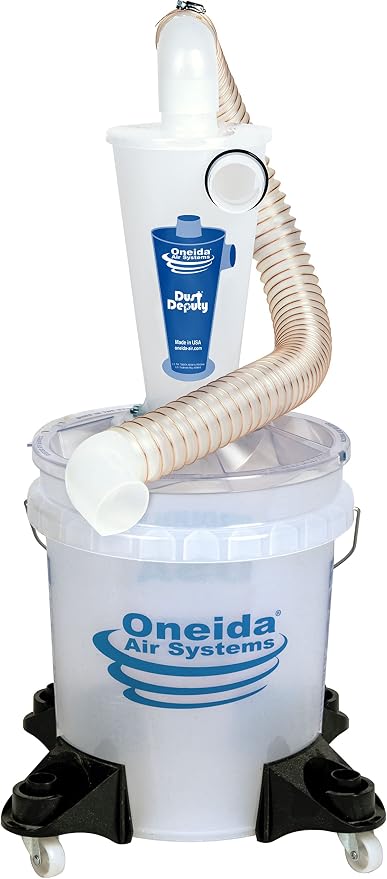
Think of being elbow-deep in sawdust and, every time you pull the trigger to your shop vac, the filter gets clogged like it’s done with one-too-many coffee grounds—that’s where the Oneida Air Systems Dust Deputy Deluxe Cyclone Separator Kit comes in. This cyclone wizard bolts to any wet/dry vacuum, and uses the exclusive Neutral Vane Technology (NVT) to produce sustained centrifugal forces that spin the fine dust and debris out of the airstream and into its own anti-static container. Translation? No more struggling to remove your filter, no more clogged filters to clean, and no more hassle. Its injection-molded, clear-resin construction offers resistance to static shocks and they let you eyeball dust levels with a glance, which is useful for knowing when to empty.
When you’re going for that out-of-body sanding experience, the four caster mounts and non-marking wheels turn this shop tool into the baddest ride in the shop; and with the molded Vortex lid, you get that dust out of your hair the second it leaves the filter. With 2 1/2″ hose fittings, plus a sweat-fit adapter with rubber inlays, a three-foot anti-static hose and everything you need to set up airtight connections with your hose, you’ll be ready to wreck that nail-breaking drywall dust, tear through the three-alarm concrete dust, or suck up all that pet hair with no loss of performance. In other words, the Dust Deputy Deluxe isn’t an upgrade, it’s the workhorse partner-in-crime you never knew you needed. So hang on, because next we’re going to step machines operations, dust bunnies and the crime scene investigators who bring them all together.
4. JET Vortex Cone Dust Collector – Best Midrange Dust Collector

Well, if you don’t feel like choking on sawdust while your saw screams like a banshee, then you need the help of the JET Vortex Cone Dust Collector – your personal back-up in the fight against wood shredding. Its distinctive Vortex Cone removes chips from your airflow, so that beefy 1-1/2-HP motor’s not battling a clogged filter every five minutes; it delivers great suction all day long, sucking through planers, jointers, band saw just like you wanted. And that 2-micron canister filter collects the smallest of particles for cleaner air and fewer sneezing fits.
Its single-stage construction and permanently-lubricated, fan-cooled insides mean this machine just ticks quietly and efficiently along, so you still hear those brilliant ideas of yours and not a jet-liner drone. Four casters and quick-connect collection bags let you wheel it anywhere and switch them out in seconds—no plumber’s tape or swearing necessary. It’s an hour of assembly tops, even if you mutter, lose screws in the carpet and argue with your spouse about what appliqué goes where. When you’re turning your chambers into a room dedicated for woodworking, you need a friend like the JET Vortex Cone. Don’t go far—coming up, a collector who can make dust into dollars!
5. Shop Fox W1666-2 HP Dust Collector – Best Budget Dust Collector

W1666 and W1666W Dust Collector The Shop Fox W1666‑2 HP Dust Collector is your new best friend whether as a workshop companion or on the go cleanup duty. At its center is a 2‑horsepower motor that drives a heavy‑duty 12‑inch steel impeller that sucks in up to 1,550 cubic feet of air per minute, so not even the tiniest wood particles escape its whirlwind. So what does that mean for us? Shutterstock lines, Glossier finishes and a healthier breathing zone for marathon build sessions.
Its 2.5‑micron felt filter bag catches and traps the finest dust and debris, and the large 5.4‑cubic‑foot lower bag allows you to easily empty it less often, so you can continue to work without having to stop and change the bag. The heavy powder‑coated frame along with the Y‑fitting inlet easily allows you to join two machines at the same time, let’s say, your planer and jointer working in unison, and move it from corner to corner in your shop.
Dust Collector Buying Guide:
If you spend time in a workshop—whether it’s woodworking, metalworking, or even hobby crafting—you’ve probably noticed how quickly dust takes over. Beyond the mess, fine particles in the air can cause respiratory problems and damage tools over time. A dust collector isn’t just about cleanliness; it’s about safety, efficiency, and extending the life of your equipment. But with so many types and features available, how do you know which one is right for you? Let’s break it down.
Why You Need a Dust Collector
Before diving into features, it’s worth understanding why investing in a dust collector matters.
-
Health and Safety: Fine sawdust, metal shavings, and debris can irritate lungs and eyes, or even become explosive in certain settings.
-
Cleaner Workspace: Less sweeping means more working, and your tools won’t be covered in layers of dust.
-
Protects Equipment: Machines last longer when motors and bearings stay clear of dust.
-
Better Results: A clean cut or smooth finish is easier when surfaces aren’t buried in debris.
Types of Dust Collectors
Dust collectors come in several forms. Choosing the right one depends on your shop size, workflow, and how often you run dust-producing tools.
-
Single-Stage Collectors
-
Air and debris are sucked in and collected in one container.
-
Best for small workshops or one-tool-at-a-time setups.
-
Affordable but may clog faster with fine dust.
-
-
Two-Stage (Cyclone) Collectors
-
Use a cyclone to spin heavy chips and dust into a bin before the air reaches the filter.
-
More efficient, less filter clogging, better for fine dust.
-
Larger and pricier, but ideal for frequent or multi-tool use.
-
-
Portable Shop Vacs
-
Compact, versatile, and easy to move.
-
Great for small spaces, power tools, or cleanup tasks.
-
Limited capacity and airflow compared to larger systems.
-
-
Central Dust Collection Systems
-
Designed to connect multiple machines with ductwork.
-
Perfect for professional shops or anyone running several tools at once.
-
Higher cost, requires planning and installation.
-
Key Features to Consider
1. Airflow (CFM)
Measured in cubic feet per minute (CFM), this tells you how much air the collector can move.
-
Small tools (like sanders, drills): 150–300 CFM.
-
Table saws, planers, jointers: 400–800 CFM.
-
Larger professional setups: 1,000+ CFM.
Tip: Don’t undersize—always match the collector to your dustiest tool.
2. Motor Power (HP)
The motor drives suction strength.
-
Small hobby units: 0.5–1 HP.
-
Mid-range workshop units: 1.5–2 HP.
-
Heavy-duty professional: 3+ HP.
More power isn’t always better if you don’t need it, but underpowered units struggle to keep up.
3. Filtration System
Filters decide what stays in the air.
-
Standard filters: Capture larger particles (not great for fine dust).
-
HEPA filters: Trap microscopic particles, essential if air quality is a concern.
-
Micron ratings: Look for 1 micron or less for fine dust control.
4. Capacity
Dust collectors fill up faster than you think.
-
Shop vacs: 5–20 gallons.
-
Single/two-stage collectors: 30–55 gallons (sometimes more).
-
Central systems: Large bins or drums for heavy-duty use.
If you hate emptying bags constantly, go bigger.
5. Noise Level
Dust collectors can roar like jet engines.
-
Shop vacs are usually the loudest (85–95 dB).
-
Larger systems can be quieter with proper housing or mufflers.
If you’re in a shared space or working long hours, check decibel ratings.
6. Portability vs. Permanence
-
Portable collectors: On wheels, easy to move between machines.
-
Stationary systems: Stay in one place, often connected to ducting.
Think about whether your shop is flexible or fixed.
7. Build Quality and Maintenance
Durable housings, sturdy wheels, and easy-access filter bags save headaches. Also check how easy it is to replace filters, empty bins, or unclog hoses.
Additional Features Worth Noting
-
Auto Start/Stop: Turns the collector on when you power your tool.
-
Remote Control: Handy for large shops where the unit isn’t nearby.
-
Blast Gates: Control airflow to individual machines.
-
Cyclone Separators (Add-On): Can be added to shop vacs for better efficiency.
Budget Considerations
-
Entry-Level ($100–$300): Shop vacs and small portable collectors. Good for beginners or small garages.
-
Mid-Range ($300–$800): Strong single-stage collectors, some cyclones. Ideal for hobbyists and small shops.
-
High-End ($800+): Cyclone and central systems with large capacity, great for serious woodworkers or businesses.
Tips for Choosing the Right Dust Collector
-
Measure your space—don’t buy a unit that overwhelms your shop.
-
Consider your tools—a table saw and planer produce more chips than a drill press.
-
Think about the future—are you expanding your workshop later?
-
Don’t skimp on filtration—fine dust is more dangerous than large chips.
-
Balance power and noise—a unit that’s too loud may discourage you from using it.
Final Thoughts
A dust collector is more than a convenience—it’s an investment in your health, productivity, and shop longevity. Whether you’re a weekend DIYer or running a small business, matching the right type of collector to your tools and space makes all the difference.
Start by identifying your dustiest tools, decide whether portability or a fixed system suits you best, and always prioritize good filtration. From compact shop vacs to powerful cyclone systems, there’s a dust collector for every setup.
Leave a Reply